Sweet Pairings with Indian Meals: What Complements Your Menu
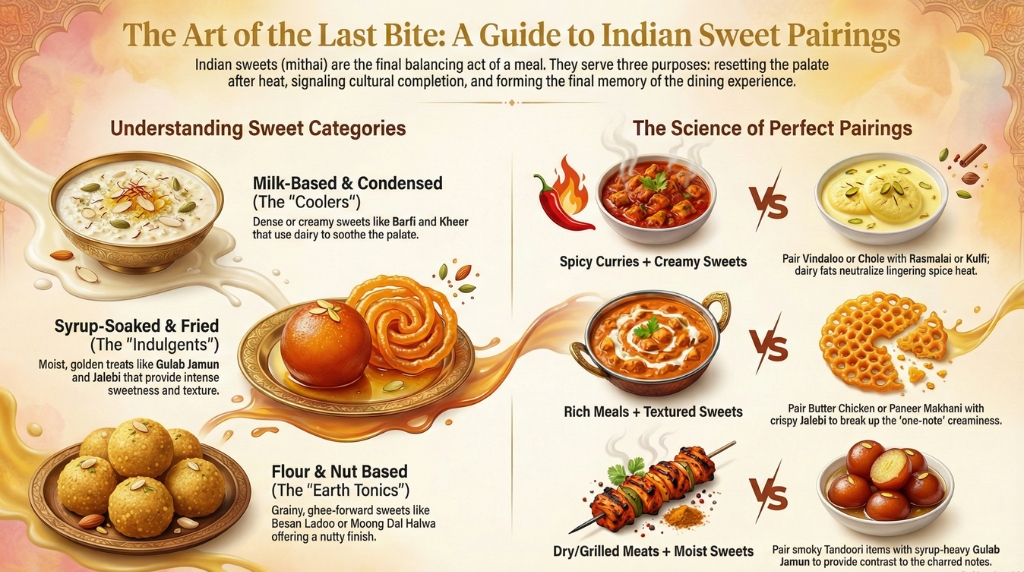
Indian meals do not end with dessert. They transition through it.
The final bite of a meal carries weight. It resets the palate. It signals completion. It leaves the impression that lingers after guests leave.
At Tadka King, we see this play out differently depending on the meal context. A family dinner needs a different sweet finish than a wedding buffet. A corporate lunch requires something different from a religious gathering.
This guide covers how to pair Indian sweets with specific meals, why certain combinations work better than others, and how to think about sweets as part of the complete food experience rather than an afterthought.
Why Sweet Pairings Matter
Indian cuisine operates on the principle of balance. Heat is offset by cooling elements. Rich dishes are balanced with lighter ones. Intense flavors are tempered by neutral carriers like rice or roti.
Palate Reset After Spice
Many Indian dishes carry heat—not always intense, but present. Chili, black pepper, ginger, and other warming spices build up over the course of a meal.
Sweets do not just satisfy sugar cravings. They reset the palate, cooling the mouth and allowing the lingering flavors to settle rather than overwhelm.
Memory Formation
People remember the last thing they experience more vividly than what came before. This is why restaurants obsess over dessert courses.
The sweet you serve at the end of an Indian meal becomes part of how people remember the entire event. A well-chosen mithai leaves a better impression than an expensive main course paired with no dessert.
Cultural Completion
In Indian food culture, serving sweets signals that the meal is complete. It is a gesture of hospitality, a sign that the host has thought through the entire experience.
Even in casual settings, offering something sweet—even just a single piece of jalebi or a small bowl of kheer—carries meaning beyond taste.
Understanding Sweet Categories for Pairing
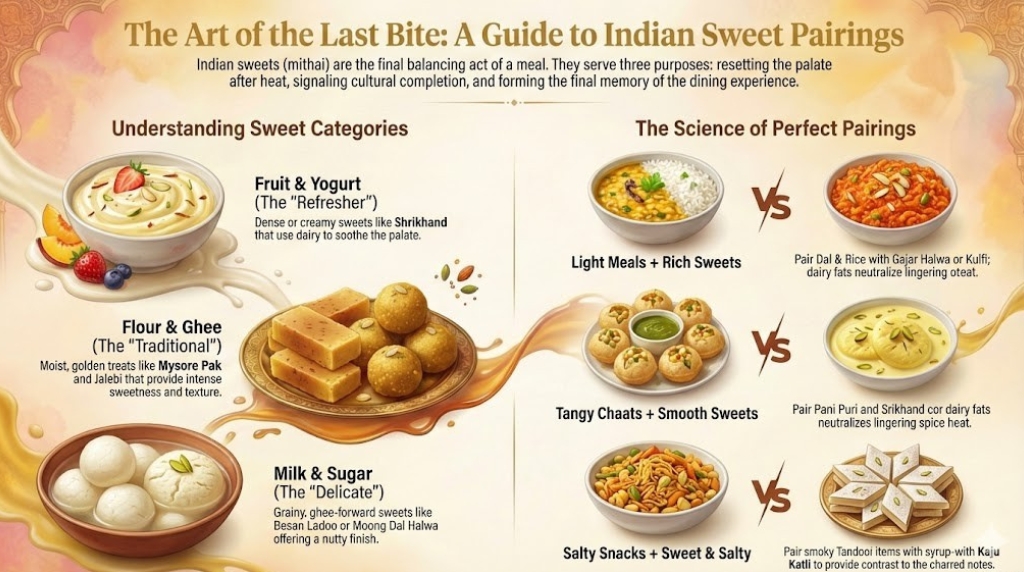
Indian sweets fall into distinct categories based on base ingredients, texture, and flavor intensity. Pairing effectively means understanding these differences.
Food is prepared in the kitchen, packed in trays, delivered to your location. You or your team handles setup and serving.
Milk-Based Sweets (Barfi, Peda, Kalakand)
Texture:
Dense, fudge-like, slightly crumbly
Flavor Profile:
Mildly sweet, rich, creamy, often flavored with cardamom or saffron
Weight:
Heavy Milk-based sweets are substantial. They satisfy but can feel heavy after a large meal.
Best paired with:
Light meals, vegetable-focused menus, or served in small portions after rich meals
Syrup-Soaked Sweets (Gulab Jamun, Jalebi, Rasmalai)
Texture:
Soft, moist, syrup-saturated
Flavor Profile:
Very sweet, often rose or cardamom-scented
Weight:
Moderate to heavy These sweets are indulgent and unapologetically sweet. They work best when the meal itself is not overly rich.
Best paired with:
Tandoori dishes, grilled items, lighter curries, rice-based meals
Fried Sweets (Jalebi, Imarti, Balushahi)
Texture:
Crispy or flaky exterior, often syrup-soaked
Flavor Profile:
Sweet with slight texture contrast
Weight:
Moderate The crunch factor makes these sweets feel lighter than they are. They provide textural variety after a soft, saucy meal.
Best paired with:
Heavy curries, creamy dishes, dal-based meals
Condensed/Reduced Sweets (Kheer, Rabri, Phirni)
Texture:
Creamy, pudding-like
Flavor Profile:
Mildly sweet, often nutty, cardamom or saffron-forward
Weight:
Light to moderate These sweets feel like a continuation of the meal rather than a sharp departure. They are comforting and gentle.
Best paired with:
Spicy meals, biryani, tandoori platters, grilled meats
Besan/Gram Flour Sweets (Besan Ladoo, Mohanthal, Mysore Pak)
Texture:
Crumbly, rich, grainy
Flavor Profile:
Nutty, ghee-forward, moderately sweet
Weight:
Heavy These sweets carry a distinct roasted flavor from the gram flour and ghee. They are rich and satisfying in small quantities.
Best paired with:
Light lunches, tea service, festive meals where variety is expected
Coconut-Based Sweets (Nariyal Barfi, Coconut Ladoo)
Texture:
Chewy, slightly grainy
Flavor Profile:
Sweet, coconut-forward, sometimes cardamom-spiced
Weight:
Moderate Coconut provides natural sweetness and a distinct texture. These sweets feel tropical and slightly lighter than pure milk-based options.
Best paired with:
South Indian meals, coastal curries, lighter vegetarian spreads
Sweet Pairings by Meal Type
Different meal contexts require different sweet approaches. What works for a family dinner does not work for a 200-person wedding buffet.
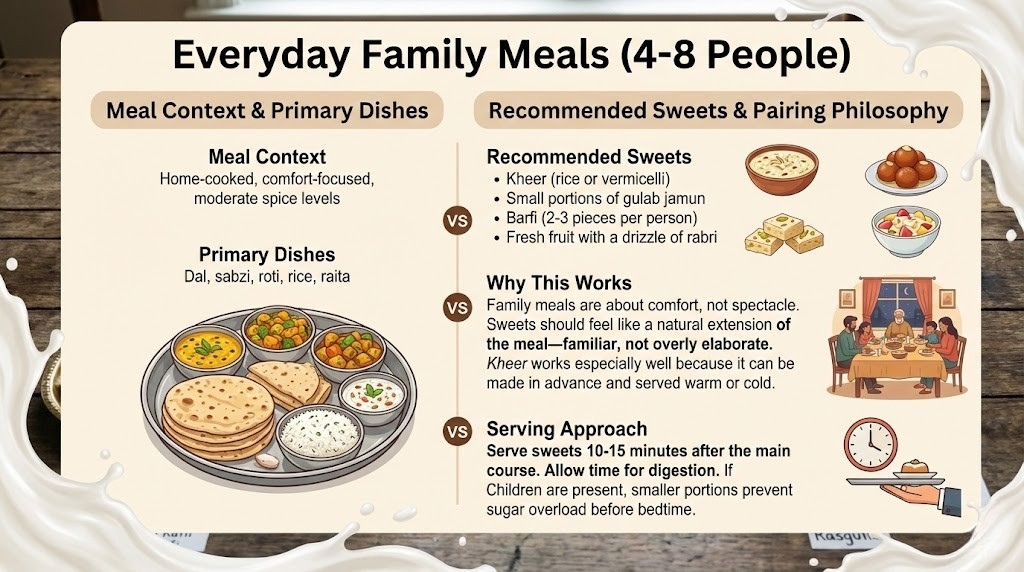
Everyday Family Meals (4-8 People)
Meal Context:
Home-cooked, comfort-focused, moderate spice levels
Primary Dishes:
Dal, sabzi, roti, rice, raita
Recommended Sweets:
Kheer (rice or vermicelli)
Small portions of gulab jamun
Barfi (2-3 pieces per person)
Fresh fruit with a drizzle of rabri
Why This Works:
Family meals are about comfort, not spectacle. Sweets should feel like a natural extension of the meal—familiar, not overly elaborate. Kheer works especially well because it can be made in advance and served warm or cold.
Serving Approach:
Serve sweets 10-15 minutes after the main course. Allow time for digestion. If children are present, smaller portions prevent sugar overload before bedtime.
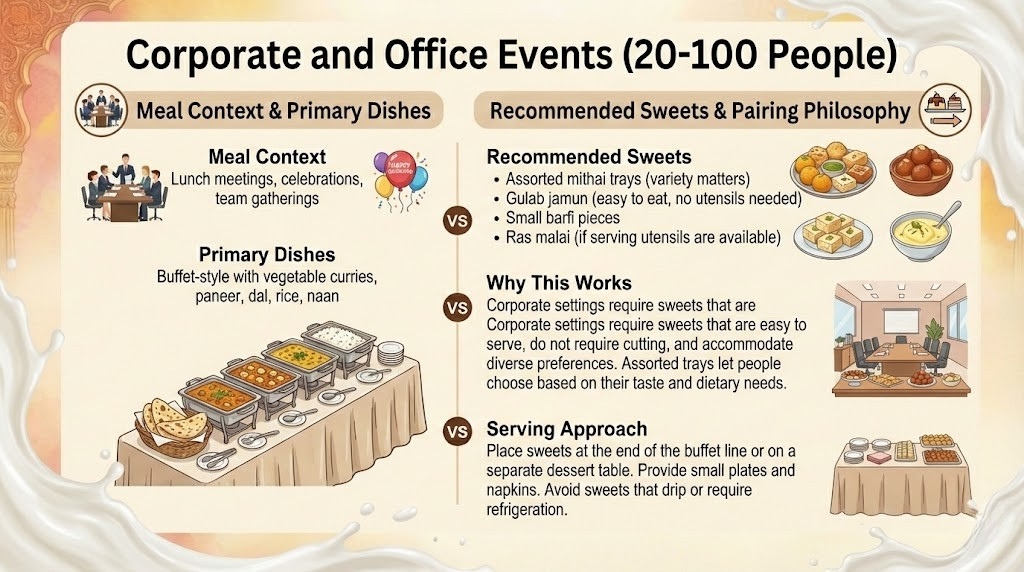
Corporate and Office Events (20-100 People)
Meal Context:
Lunch meetings, celebrations, team gatherings
Primary Dishes:
Buffet-style with vegetable curries, paneer, dal, rice, naan
Recommended Sweets:
Assorted mithai trays (variety matters)
Gulab jamun (easy to eat, no utensils needed)
Small barfi pieces
Ras malai (if serving utensils are available)
Why This Works:
Corporate settings require sweets that are easy to serve, do not require cutting, and accommodate diverse preferences. Assorted trays let people choose based on their taste and dietary needs.
Serving Approach:
Place sweets at the end of the buffet line or on a separate dessert table. Provide small plates and napkins. Avoid sweets that drip or require refrigeration.
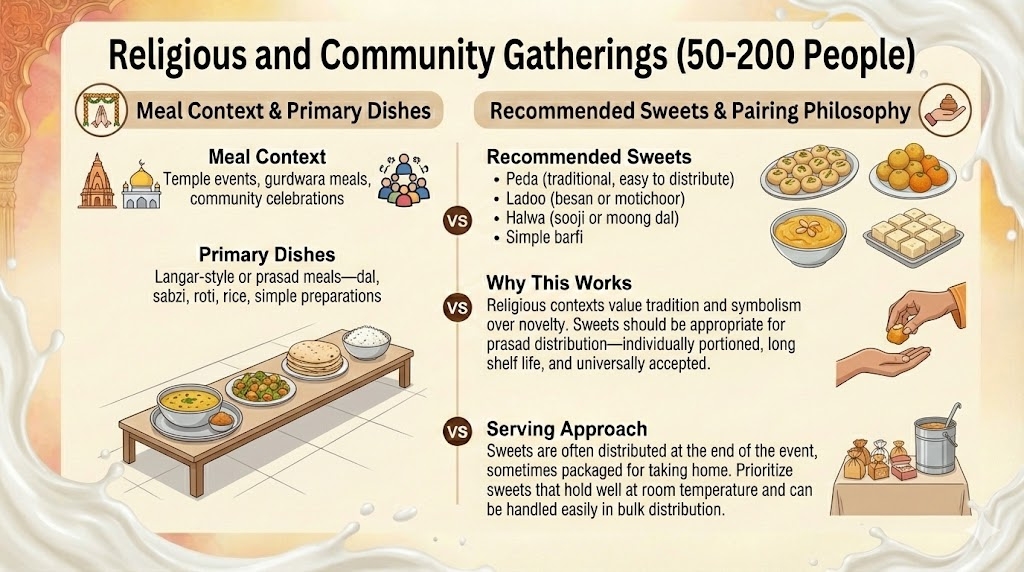
Religious and Community Gatherings (50-200 People)
Meal Context:
Temple events, gurdwara meals, community celebrations
Primary Dishes:
Langar-style or prasad meals—dal, sabzi, roti, rice, simple preparations
Recommended Sweets:
Peda (traditional, easy to distribute)
Ladoo (besan or motichoor)
Halwa (sooji or moong dal)
Simple barfi
Why This Works:
Religious contexts value tradition and symbolism over novelty. Sweets should be appropriate for prasad distribution—individually portioned, long shelf life, and universally accepted.
Serving Approach:
Sweets are often distributed at the end of the event, sometimes packaged for taking home. Prioritize sweets that hold well at room temperature and can be handled easily in bulk distribution.
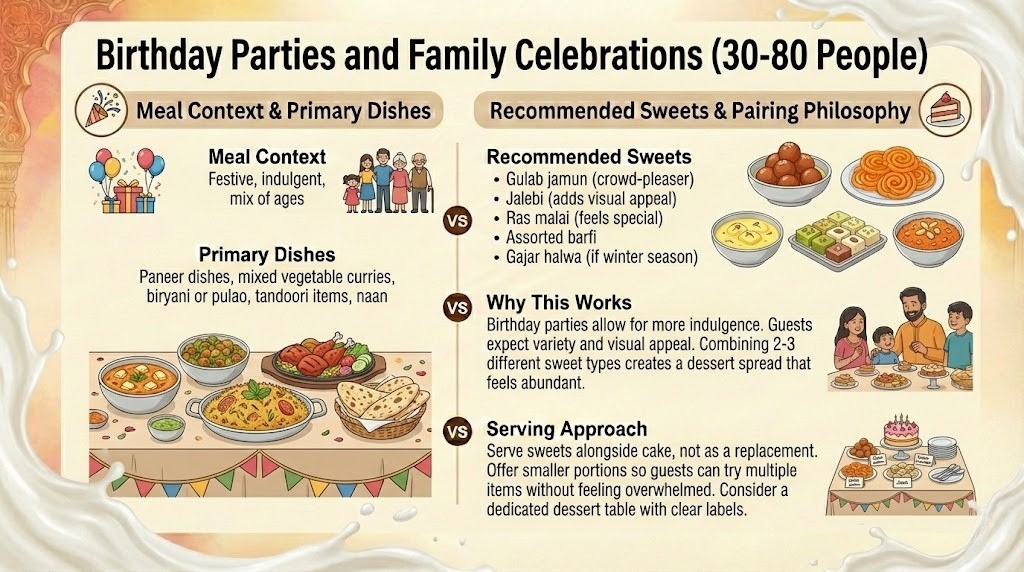
Birthday Parties and Family Celebrations (30-80 People)
Meal Context:
Festive, indulgent, mix of ages
Primary Dishes:
Paneer dishes, mixed vegetable curries, biryani or pulao, tandoori items, naan
Recommended Sweets:
Gulab jamun (crowd-pleaser)
Jalebi (adds visual appeal)
Ras malai (feels special)
Assorted barfi
Gajar halwa (if winter season)
Why This Works:
Birthday parties allow for more indulgence. Guests expect variety and visual appeal. Combining 2-3 different sweet types creates a dessert spread that feels abundant.
Serving Approach:
Serve sweets alongside cake, not as a replacement. Offer smaller portions so guests can try multiple items without feeling overwhelmed. Consider a dedicated dessert table with clear labels.
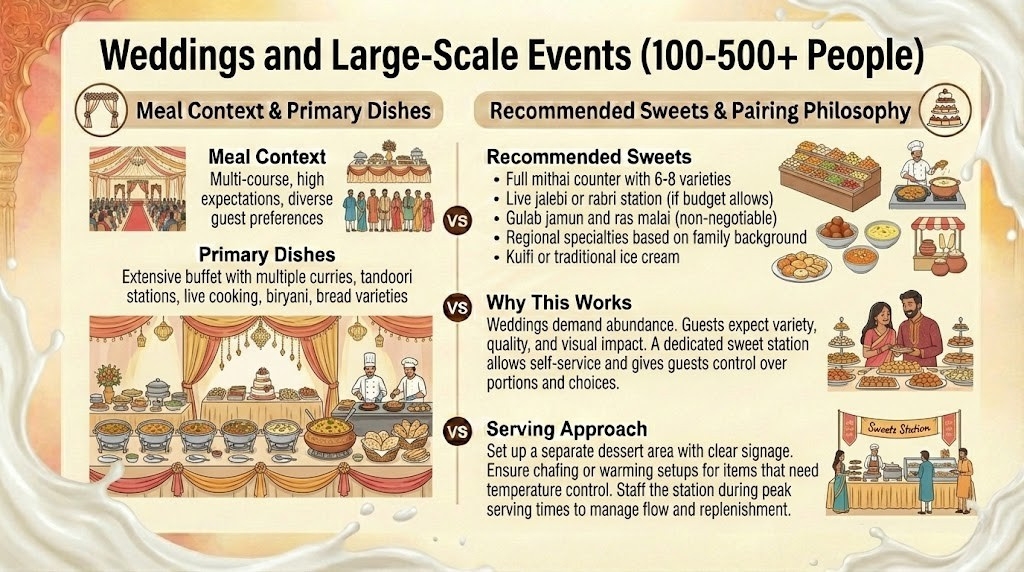
Weddings and Large-Scale Events (100-500+ People)
Meal Context:
Multi-course, high expectations, diverse guest preferences
Primary Dishes:
Extensive buffet with multiple curries, tandoori stations, live cooking, biryani, bread varieties
Recommended Sweets:
Full mithai counter with 6-8 varieties
Live jalebi or rabri station (if budget allows)
Gulab jamun and ras malai (non-negotiable)
Regional specialties based on family background
Kulfi or traditional ice cream
Why This Works:
Weddings demand abundance. Guests expect variety, quality, and visual impact. A dedicated sweet station allows self-service and gives guests control over portions and choices.
Serving Approach:
Set up a separate dessert area with clear signage. Ensure chafing or warming setups for items that need temperature control. Staff the station during peak serving times to manage flow and replenishment.
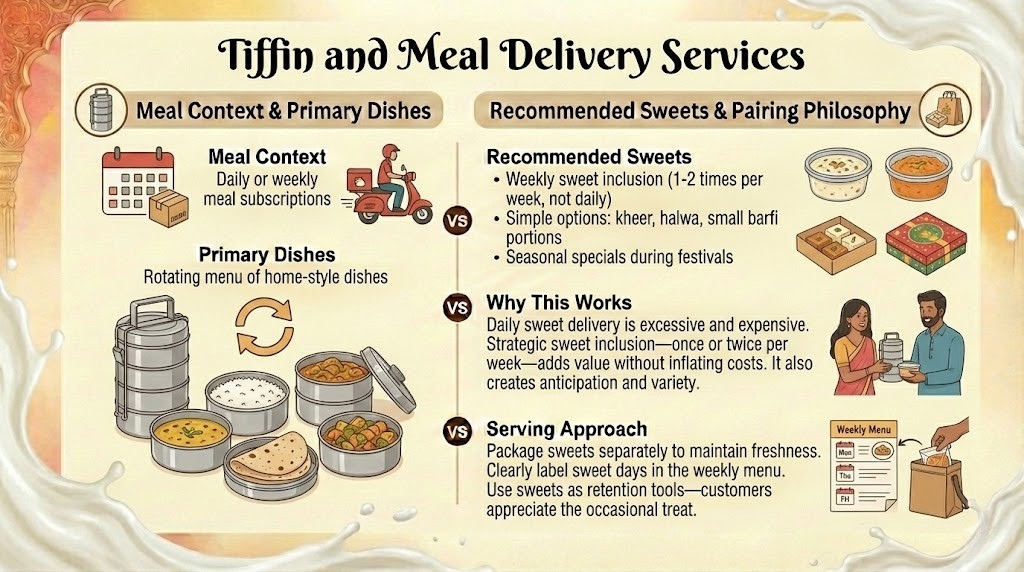
Tiffin and Meal Delivery Services
Meal Context:
Daily or weekly meal subscriptions
Primary Dishes:
Rotating menu of home-style dishes
Recommended Sweets:
Weekly sweet inclusion (1-2 times per week, not daily)
Simple options: kheer, halwa, small barfi portions
Seasonal specials during festivals
Why This Works:
Daily sweet delivery is excessive and expensive. Strategic sweet inclusion—once or twice per week—adds value without inflating costs. It also creates anticipation and variety.
Serving Approach:
Package sweets separately to maintain freshness. Clearly label sweet days in the weekly menu. Use sweets as retention tools—customers appreciate the occasional treat.
Pairing Sweets with Specific Dishes
Certain dishes pair better with specific sweets. This is not rigid science, but understanding the logic helps with planning.
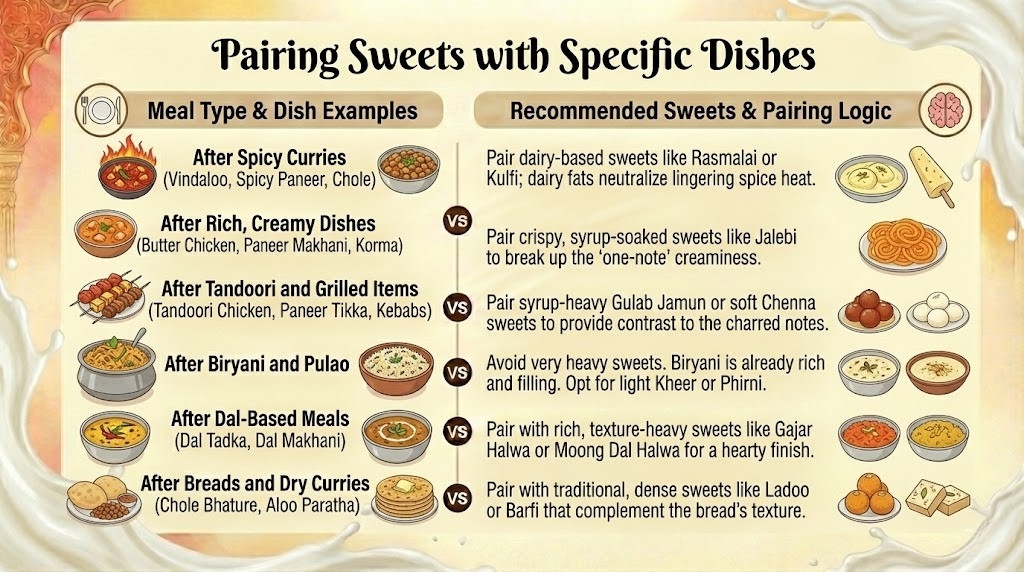
After Spicy Curries (Vindaloo, Spicy Paneer, Chole)
Recommended Sweets:
Kheer, rasmalai, kulfi
Why:
Cream-based or milk-based sweets provide immediate cooling. The fat content helps neutralize capsaicin. The mild sweetness resets the palate without overwhelming already intense flavors.
Avoid:
Very sweet or syrup-heavy options like jalebi. The contrast is too sharp and can feel cloying after spicy food.
After Rich, Creamy Dishes (Butter Chicken, Paneer Makhani, Korma)
Recommended Sweets:
Jalebi, besan ladoo, fruit-based desserts
Why:
Rich meals need lighter sweets or those with textural contrast. Jalebi's crispness offsets creaminess. Besan ladoo's nutty flavor provides a different taste profile without adding more dairy.
Avoid:
Barfi or peda. More cream and milk after a cream-heavy meal feels redundant.
After Tandoori and Grilled Items (Tandoori Chicken, Paneer Tikka, Kebabs)
Recommended Sweets:
Gulab jamun, rasmalai, phirni
Why:
Grilled dishes are relatively dry and carry smoky, charred notes. Moist, syrup-soaked sweets provide contrast and help cleanse the palate of char flavor.
Avoid:
Dry sweets like balushahi. The texture contrast is not strong enough.
After Biryani and Pulao
Recommended Sweets:
Kheer, shahi tukda, fruit custard
Why:
Rice-based meals pair naturally with rice-based desserts. The familiarity feels intentional. Kheer, in particular, mirrors the base ingredient while transforming the flavor profile entirely.
Avoid:
Very heavy sweets. Biryani is already rich and filling.
After Dal-Based Meals (Dal Tadka, Dal Makhani)
Recommended Sweets:
Jalebi, gulab jamun, moong dal halwa
Why:
Dal meals are relatively simple. Sweets can be more elaborate without clashing. Jalebi adds sweetness and crunch. Moong dal halwa ties back to the meal's base ingredient in a creative way.
Avoid:
Nothing is off-limits here. Dal is neutral enough to pair with nearly any sweet.
After Breads and Dry Curries (Chole Bhature, Aloo Paratha)
Recommended Sweets:
Rabri, rasmalai, kulfi
Why:
Dry, heavy meals benefit from moist, creamy sweets. The texture contrast and cooling effect balance the meal.
Avoid:
Besan-based sweets. The grainy texture is too similar to dry curries.
Seasonal Considerations for Sweet Pairings
Indian sweets have seasonal relevance. Serving the right sweet at the right time enhances the experience.
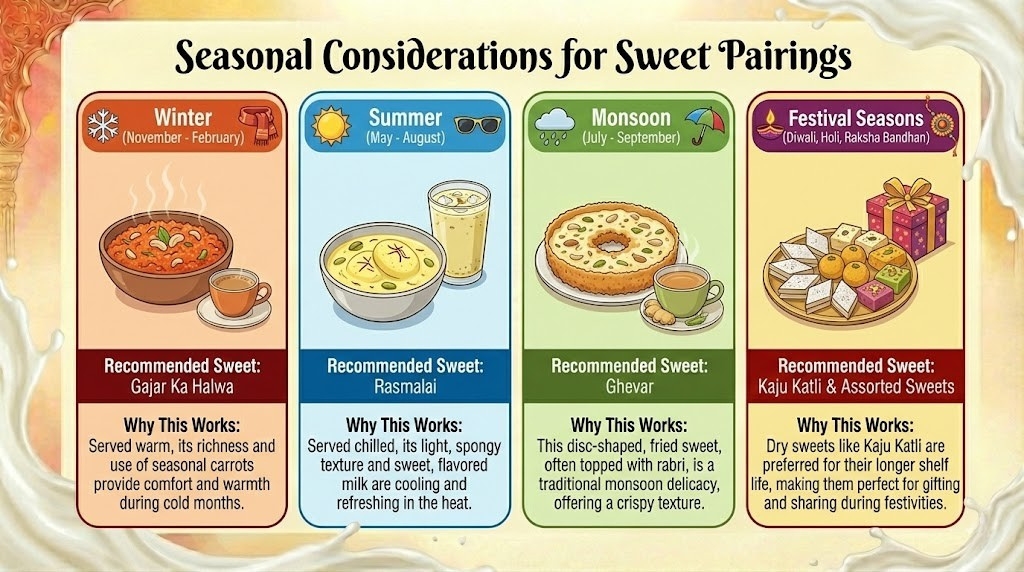
Winter (November - February)
Recommended Sweets:
Gajar halwa, moong dal halwa, til ladoo, gond ke ladoo
Why:
Winter sweets are warming, often made with ghee, nuts, and ingredients believed to generate body heat. They feel comforting and appropriate for the season.
Best Meals to Pair With:
Heavier curries, dal makhani, rajma, sarson ka saag
Summer (May - August)
Recommended Sweets:
Kulfi, rasmalai, phirni, fruit-based desserts
Why:
Cooling sweets that can be served chilled. They provide relief from heat and pair well with lighter summer meals.
Best Meals to Pair With:
Tandoori dishes, grilled items, lighter vegetable curries
Monsoon (July - September)
Recommended Sweets:
Jalebi, malpua, kheer
Why:
Monsoon is the season for hot, fried sweets paired with chai. The combination feels cozy during rainy evenings.
Best Meals to Pair With:
Pakoras, samosas, light snacks, chai service
Festival Seasons (Diwali, Holi, Raksha Bandhan)
Recommended Sweets:
Whatever is traditional for the festival—kaju katli (Diwali), gujiya (Holi), motichoor ladoo (Raksha Bandhan)
Why:
Festival sweets carry cultural significance beyond taste. Serving traditional sweets shows respect for the occasion.
Best Meals to Pair With:
Festive meals vary, but sweets are prioritized over regular desserts during these times.
How to Structure a Sweet Menu for Events
For catered events, the sweet menu should mirror the complexity and formality of the main meal.
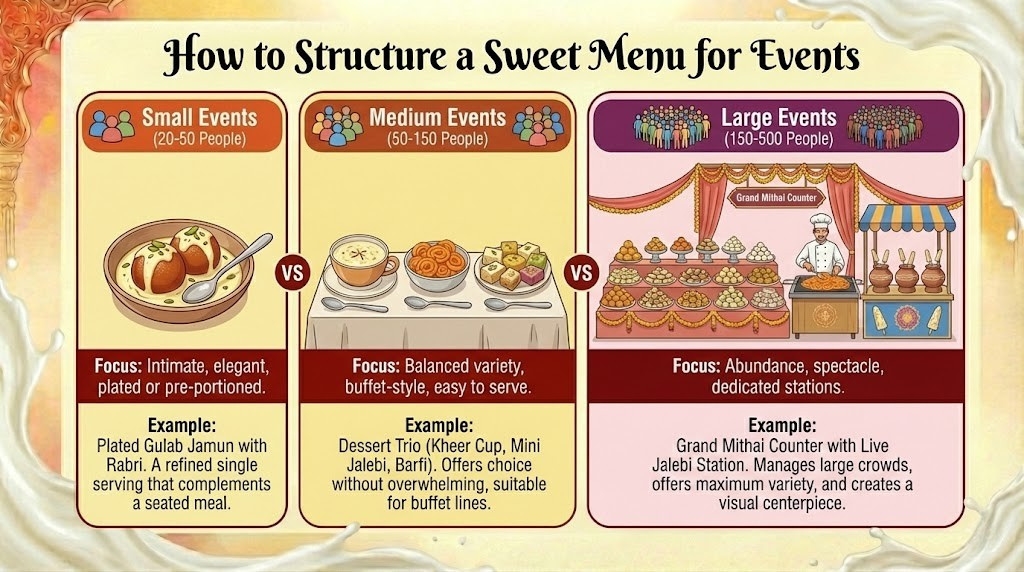
Small Events (20-50 People)
Sweet Options:
2-3 varieties
Quantity:
2-3 pieces per person
Format:
Served on platters or individual small plates
Sample Menu:
Gulab jamun
Assorted barfi
Seasonal option (gajar halwa in winter, kulfi in summer)
Medium Events (50-150 People)
Sweet Options:
4-5 varieties
Quantity:
3-4 pieces per person
Format:
Buffet-style dessert table
Sample Menu:
Gulab jamun
Rasmalai
Barfi (2 varieties)
Jalebi
Kheer or phirni
Large Events (150-500 People)
Sweet Options:
6-8 varieties
Quantity:
4-5 pieces per person
Format:
Dedicated dessert station with service staff
Sample Menu:
Gulab jamun
Rasmalai
Barfi (3 varieties: plain, chocolate, pistachio)
Gajar halwa or moong dal halwa
Kulfi or traditional ice cream
Fresh fruit platter with rabri
Common Mistakes in Sweet Pairings
Mistake 1: Too Much Similarity
Serving milk-based sweets after a cream-heavy meal creates flavor fatigue. The entire experience feels one-note.
Solution:
Vary the base ingredients. If the meal is cream-heavy, choose syrup-based or fried sweets for contrast.
Mistake 2: Ignoring Guest Capacity
After a full buffet meal, guests have limited capacity for sweets. Serving 5-6 varieties at a small event leads to waste.
Solution:
Scale sweet variety to event size and meal heaviness. Fewer options in larger portions often works better than many options in small amounts.
Mistake 3: Temperature Mismanagement
Serving room-temperature rasmalai or melted kulfi ruins the experience.
Solution:
Plan for temperature control. If your event does not have refrigeration access, choose sweets that hold well at room temperature—barfi, ladoo, jalebi.
Mistake 4: No Dietary Accommodation
Assuming everyone eats dairy-heavy sweets excludes vegan guests and those with lactose intolerance.
Solution:
Include at least one non-dairy option—coconut-based sweets, fruit-based desserts, or sorbets.
How Tadka King Handles Sweet Pairings
At Tadka King, sweets are not a separate department. They are part of the full meal planning conversation.
Integrated Menu Planning
When you book catering with us, we discuss sweets during the same conversation as main dishes. This ensures:
Sweets complement the meal, not clash with it
Quantities match the event size and meal heaviness
Dietary needs are addressed across the full menu
Flexible Sweet Options
We do not force package deals. If your meal calls for light sweets, we recommend accordingly. If your event demands abundance, we scale up.
You get what fits, not what we need to move from inventory.
Same-Kitchen Coordination
Because sweets and catering come from the same kitchen, delivery timing is synchronized. Everything arrives together, properly packed, at the right temperature.
No juggling multiple vendors. No wondering if the sweet order will show up.
Seasonal and Cultural Awareness
We know when gajar halwa makes sense and when it does not. We understand festival contexts and regional preferences. This is not just about taste—it is about appropriateness.
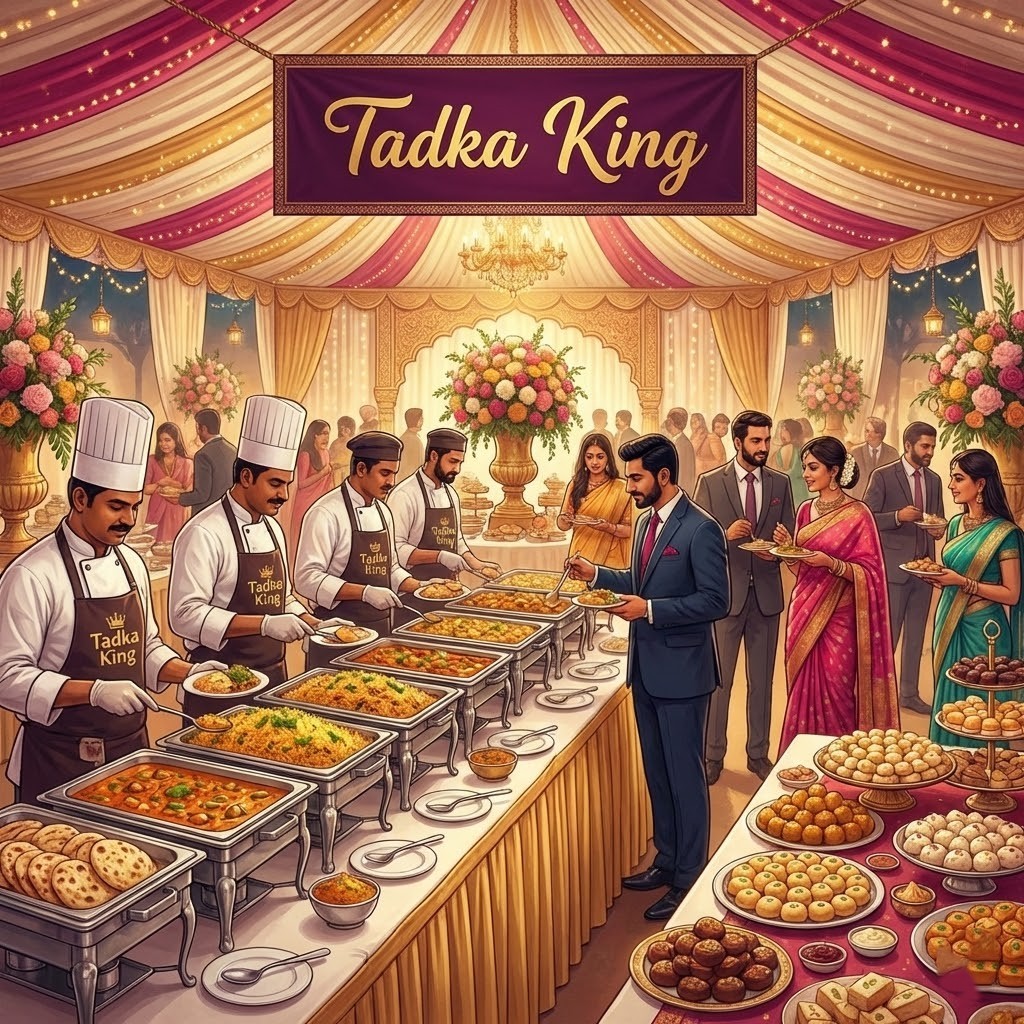
This is the Tadka King.
Indian meals are not just food. They’re experiences built on balance, timing, and hospitality.
At Tadka King, we design catering as a complete system — from menu structure and sweet pairings to logistics, flow, and guest experience.
From family gatherings to weddings and large-scale events, we deliver food that arrives on time, at the right temperature, in the right quantities — with flavors that complement the meal, not compete with it.
Final Thought: Sweets Complete the Experience
Indian meals are built on balance. The right sweet at the end does not just satisfy a craving. It resets the palate, signals completion, and becomes the memory guests carry forward.
Poor sweet pairing—or no sweet at all—leaves meals feeling unfinished. Good pairing leaves guests satisfied in a way that goes beyond fullness.
At Tadka King, we treat sweets as part of the full food system. Whether you are planning a family dinner, a corporate lunch, or a wedding for 300, the sweet course gets the same attention as the main menu.
Because if the last bite does not land right, the whole meal feels off.
Tadka King – Sweets, Food, and Catering in Brampton
35 Main St N, Brampton, ON L6X 1M8
Phone: (905) 230-0102
Open 24/7 – Full menu including sweets, any hour
Frequently Asked Questions (FAQs)
Why do sweet pairings matter in Indian meals?
Sweets reset the palate after spices, signal meal completion as hospitality, and form lasting memories via the final bite. They balance heat with cooling (e.g., gulkand, fennel) and offset rich flavors, elevating the full experience.
Which sweets pair best with spicy curries or biryani?
Cooling options like kheer, rasmalai, kulfi, or phirni neutralize capsaicin and smoky notes. For biryani, rice-based desserts like kheer mirror the base while refreshing; avoid heavy syrup sweets post-spice.
What sweets suit different event sizes at Tadka King?
Small events (20-50): 2-3 varieties like gulab jamun and barfi (2-3 pieces/person). Medium (50-150): 4-5 on buffet (e.g., rasmalai, jalebi). Large weddings (150+): 6-8 at dedicated station with staff.
How to avoid common sweet pairing mistakes?
Vary bases post-creamy meals (e.g., jalebi after butter chicken), scale varieties to event size, manage temperatures (room-temp barfi if no fridge), include non-dairy (coconut ladoo), and present neatly with labels.
Why choose Tadka King for integrated sweet pairings?
Sweets are planned with mains from one kitchen for synchronized delivery, seasonal/cultural fit, flexible scaling (20-500 guests), and full dietary handling—no vendor chaos, just balanced meals 24/7 in Brampton.

Swaran Sandhu
Swaran Sandhu has 8+ years of experience in the HoReCa industry and a passion for writing about food, restaurants, and Indian cuisine, especially covering locations across Ontario (Canada).